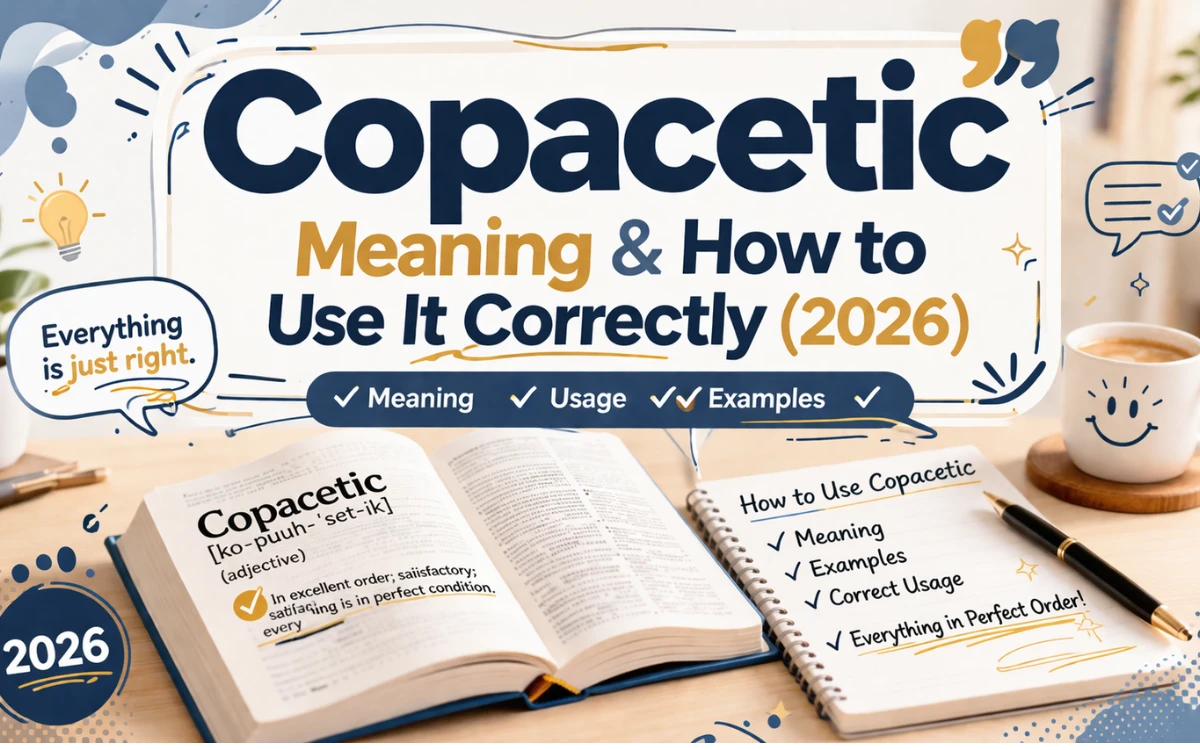
Copacetic means everything is perfectly fine, completely satisfactory, and in excellent order.
It is an informal American English adjective used to express that a situation, relationship, or condition is going well — no problems, no worries.
If someone says “it’s all copacetic,” they simply mean everything is good.
What Does Copacetic Mean and How Do You Use It Correctly?
Copacetic is an adjective.
It describes something as:
- Very satisfactory
- Completely fine
- In excellent order
- Totally acceptable
It works at the sentence level like this:
| Context | Example |
| Work | “The project is copacetic — no issues at all.” |
| Relationships | “After the talk, things between us were copacetic again.” |
| Daily life | “Don’t worry, everything is copacetic.” |
| Events | “Despite the delay, the event turned out copacetic.” |
More Post: JFC Meaning in Text (2026): Usage & Alternatives
Key rule: You use it to reassure someone or describe a smooth situation.
It carries a calm, confident, almost laid-back energy.
Think of it as a slightly more expressive and stylish way to say “all good.”
How to Pronounce and Spell Copacetic Without Making a Mistake
Pronunciation:
koh – puh – SET – ik
The stress falls on the third syllable — SET.
Say it slowly: co · pa · cet · ic
Spelling variants accepted in 2026:
| Spelling | Status |
| copacetic | Standard — use this one |
| copasetic | Accepted variant |
| copesetic | Accepted variant |
| copesettic | ❌ Wrong — avoid |
| copesatic | ❌ Wrong — avoid |
More Posts:Snowball Kiss Meaning: Definition & Viral Origin
Always go with copacetic.
Every major dictionary — Merriam-Webster, Oxford, Collins — recognizes it as the correct primary spelling.
When in doubt, stick to the standard.
Where Did the Word Copacetic Actually Come From?
This is where it gets interesting.
Nobody knows for certain.
The first recorded use of copacetic dates back to 1919 in a novel called A Man for the Ages by Irving Bacheller — a story set in Abraham Lincoln’s era in rural Illinois.
After that, it appeared in 1920 African American music lyrics and was later associated with tap dance legend Bill “Bojangles” Robinson, who claimed he invented it in the 1930s.
Theories on its origin:
- 🔹 African American Vernacular English (AAVE) — most widely supported
- 🔹 Louisiana Creole French — coupe-sètique — no confirmed evidence
- 🔹 Hebrew — hakol beseder (“all is in order”) — thoroughly debunked
- 🔹 Italian — copasetti — suggested but unproven
- 🔹 Chinook Jargon — not actually attested
Bottom line: The origin is officially listed as “obscure” by Merriam-Webster.
The mystery is part of what makes this word fascinating.
The Best Synonyms and Phrases You Can Use Instead of Copacetic
Sometimes you need a different word that fits better in tone or context.
Here are the best copacetic synonyms for 2026:
| Synonym | Best Used When |
| Fine | Everyday casual conversation |
| Alright | Quick reassurance |
| Satisfactory | Semi-formal situations |
| Hunky-dory | Informal, playful tone |
| In order | Professional or structured contexts |
| All good | Modern American slang |
| Acceptable | Neutral, straightforward tone |
| Smooth | Describing how something went |
More Post:YNS Meaning in Text: You’re Not Slick Explained
Common phrases with a similar feel:
- “We’re good to go”
- “No issues on my end”
- “Everything checks out”
- “It’s all sorted”
These NLP-related terms all carry the same semantic meaning as copacetic — reassurance, satisfaction, and order.
Real-Life Example Sentences That Show Copacetic Used the Right Way
The best way to master a word is to see it in action.
In everyday conversation:
- “I checked the schedule — everything is copacetic.”
- “We had a small disagreement, but now things are copacetic between us.”
In professional settings:
- “After the review, the manager confirmed the numbers were copacetic.”
- “The client was satisfied — the delivery was copacetic.”
In news and media style (2026 usage):
- “Things between the two teams weren’t always copacetic, but they’ve found common ground.”
- “All should be copacetic heading into the final quarter.”
Used negatively (to say things are not fine):
- “Not everything has been copacetic since the merger.”
- “Things weren’t exactly copacetic after the announcement.”
Key takeaway: Copacetic works in both positive and negative constructions.
The negative form is just as common — and just as powerful.
Is Copacetic Formal or Informal and When Should You Avoid It?
Copacetic is informal.
Collins English Dictionary specifically labels it as “US and Canadian slang.”
When it’s perfectly fine to use:
✅ Casual conversations ✅ Text messages and emails between friends ✅ Informal workplace chats ✅ Creative writing and fiction ✅ Journalism and feature writing ✅ Social media posts
When you should avoid it:
❌ Academic essays or research papers ❌ Legal or medical documents ❌ Formal business reports ❌ Official correspondence
In 2026, the word has seen a small but steady revival in American pop culture, social media, and casual professional communication.
It carries a vintage charm — slightly old-fashioned, but in a cool, confident way.
Using it correctly signals that you have a strong command of the English language.
FAQ
Q: What does copacetic mean in simple terms?
Copacetic means everything is fine, satisfactory, and in good order. It’s used to express that a situation has no problems.
Q: Is copacetic still used in 2026?
Yes. While it is considered slightly old-fashioned, it is still actively used in American English — especially in casual conversation, journalism, and social media.
Q: How do you spell copacetic correctly?
The correct and standard spelling is copacetic. The variants copasetic and copesetic are accepted but less common.
Q: Can you describe a person as copacetic?
Yes. A person can be described as copacetic when they are feeling content, at ease, or easygoing in a situation.
Q: Is copacetic formal or slang?
It is informal slang — primarily used in American and Canadian English. It should be avoided in formal academic or professional writing.
Q: Where does the word copacetic come from?
Its origin is officially listed as obscure. The first known written use was in 1919. It is most closely associated with African American Vernacular English and early 20th-century American culture.

At Romancesaba.com, we’re Soulmates with Romance. Our admin Shares Heartfelt Ideas on Love, Flirting Tips, and Dreamy Destinations to spark Deep Connections and Unforgettable Romantic Journeys.