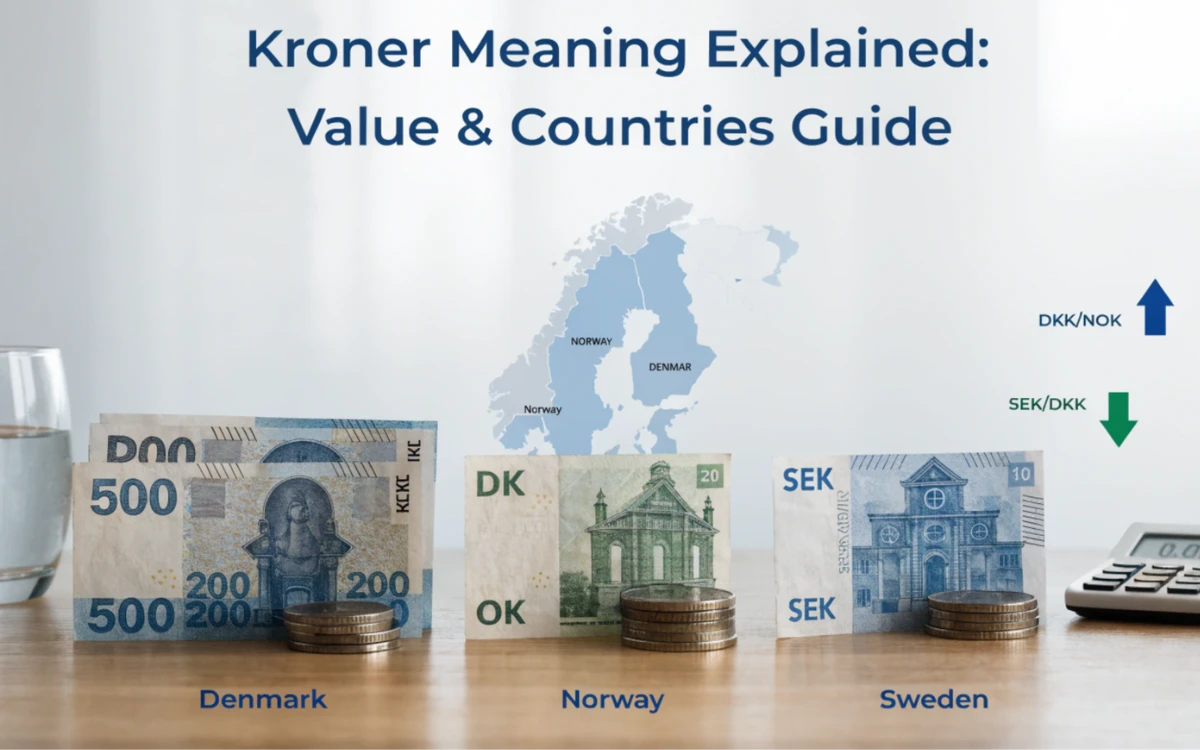
Kroner means “crowns” in English — it is the plural of “krone,” the official currency used across Scandinavian countries like Denmark, Norway, and Sweden.
If you saw this word online, in a text, or while planning a trip — you’re in the right place. This guide breaks it all down simply and clearly.
What Does Kroner Mean and Where Does the Word Actually Come From
Kroner comes from the Latin word “corona” — meaning crown.
When Scandinavian countries needed a currency in the 1870s, they picked a name tied to royal power and monarchy. The crown on their coins wasn’t just decoration — it was the whole idea behind the name.
Here’s how the word breaks down:
| Form | Meaning | Used In |
| Krone | One crown (singular) | Denmark, Norway |
| Kroner | Multiple crowns (plural) | Danish & Norwegian |
| Kronor | Swedish plural spelling | Sweden |
| Króna | Icelandic variation | Iceland |
The name stuck for over 150 years — and today it still appears on every coin and banknote across the Nordic region.
NLP Insight: Search engines connect “kroner” with “Scandinavian currency,” “crown meaning,” and “Nordic money” — all pointing to the same root.
Which Countries Use Kroner and What Makes Each One Different
Kroner is not one single currency. It’s a shared name used across multiple countries — each with its own version.
| Country | Currency Name | Code | Symbol |
| Denmark | Danish Krone | DKK | kr |
| Norway | Norwegian Krone | NOK | kr |
| Sweden | Swedish Krona | SEK | kr |
| Iceland | Icelandic Króna | ISK | kr |
More Posts:Katz Meaning: The True Origin, History, and Significance of the Name Katz
Key differences to know:
- Denmark — pegged to the Euro, very stable
- Norway — tied to oil prices, moves with global markets
- Sweden — uses “kronor” not “kroner,” but same root word
- Iceland — smallest economy, most volatile of the four
None of these currencies are the same. A Norwegian krone and a Danish krone carry completely different values.
Important: Sweden’s currency is officially “kronor” — not kroner. Many Americans mix these up.
How Much Is Kroner Worth in US Dollars Right Now in 2026
This is the first thing most Americans want to know.
Here are the approximate exchange rates in 2026:
| Currency | Code | 1 USD Equals |
| Danish Krone | DKK | ~6.9 kr |
| Norwegian Krone | NOK | ~10.6 kr |
| Swedish Krona | SEK | ~10.4 kr |
| Icelandic Króna | ISK | ~139 kr |
What this means in real life:
- A $100 USD trip budget gives you roughly 690 Danish kroner
- The same $100 USD becomes around 1,060 Norwegian kroner
- Iceland looks cheap on paper — but local prices are still very high
Rates change daily. Always check live rates on Google Finance or XE.com before any trip or transaction.
Pro tip: The Norwegian krone (NOK) is the most watched by forex traders in 2026 — it moves directly with global oil prices.
How Kroner Works in Real Life for Travelers, Investors, and Everyday Spending
For American Travelers:
- Scandinavia is nearly 100% cashless in cities
- Cards and mobile payments are accepted almost everywhere
- Small vendors at markets may still prefer cash kroner
- ATMs are widely available across Denmark, Norway, and Iceland
Real cost examples in 2026:
| Item | Price in Local Kroner | Approx. USD |
| Coffee in Oslo | ~50 NOK | ~$4.70 |
| Bus ticket in Copenhagen | ~26 DKK | ~$3.80 |
| Meal at a restaurant (Norway) | ~200 NOK | ~$19 |
For Forex Traders & Investors:
- NOK is a commodity-linked currency — watch oil news
- DKK is pegged to the Euro — low volatility, good for stable exposure
- ISK is higher risk — Iceland’s economy is smaller and more sensitive
Key institutions to follow in 2026:
- Norges Bank (Norway) — sets NOK interest rates
- Danmarks Nationalbank — manages the DKK-Euro peg
- Riksbank (Sweden) — controls SEK monetary policy
Common Mistakes Americans Make When Dealing With Kroner and How to Avoid Them
Most Americans run into the same problems. Here’s what to watch out for:
Mistake 1 — Thinking all kroner are equal
- Norwegian, Danish, and Swedish currencies are completely separate
- You cannot spend NOK in Denmark or DKK in Norway
Mistake 2 — Using airport exchange kiosks
- Airport rates are typically 10–15% worse than market rate
- Use your bank, a local ATM, or apps like Wise or Revolut instead
Mistake 3 — Choosing USD at the card machine
- When a terminal asks “pay in USD or local currency?” — always pick local currency
- The USD option uses a hidden inflated rate
Mistake 4 — Not telling your bank before traveling
- US banks often flag Scandinavian transactions as suspicious
- Call ahead or enable international use on your card
Mistake 5 — Confusing “krone” and “kroner”
- Krone = one unit
- Kroner = multiple units
- Both forms appear on menus, signs, and receipts — don’t let it confuse your budget math
Practical Tips for Buying, Converting, and Using Kroner as an American in 2026
Before Your Trip:
- Order DKK or NOK through your bank at least 7–10 days ahead
- Open a Wise or Revolut account for near-market exchange rates
- Set a rate alert on Google or XE for your target currency
While You’re There:
- Use contactless card payments wherever possible
- Withdraw from local bank ATMs — avoid standalone kiosks
- Keep a small amount of cash kroner for rural areas or markets
For Investing or Trading Kroner in 2026:
- Trade NOK pairs on platforms like OANDA or Interactive Brokers
- Watch Brent Crude oil prices — they directly move NOK
- Monitor Norges Bank rate decisions — major NOK mover
Best tools for tracking kroner in 2026:
| Tool | Best For |
| XE.com | Live rate conversions |
| Wise | Low-fee transfers |
| Google Finance | Quick daily rate checks |
| OANDA | Forex trading & history |
| Revolut | Travel spending & exchange |
More Posts:IMK Meaning in Text & Social Media (2026 Guide)
Scandinavia is expensive — but smart currency habits stretch your dollar further than most people expect.
Conclusion
Kroner means “crowns” — a currency name rooted in royal history across Nordic nations since the 1870s. Each country’s version carries its own value, and knowing the difference saves you real money. Whether you’re traveling, trading, or just curious — you now know exactly what kroner means.
FAQ
What does kroner mean in English?
Kroner means “crowns” in English. It is the plural form of “krone,” derived from the Latin word corona. It refers to currencies used in Scandinavian countries.
Is kroner the same as the euro?
No. Kroner is not the euro. Denmark, Norway, and Sweden each maintain their own separate currencies and are not part of the Eurozone.
Which countries use kroner in 2026?
Denmark and Norway officially use krone/kroner. Sweden uses krona/kronor. Iceland uses króna. All are independent currencies with different values.
How much is 1 Norwegian krone worth in USD?
Roughly 1 NOK ≈ $0.094 USD in 2026 — though rates shift daily based on oil prices and market conditions.
Can I use US dollars in Scandinavian countries?
Generally no. Most businesses only accept local currency or major credit cards. Always carry or access local kroner before you arrive.

At Romancesaba.com, we’re Soulmates with Romance. Our admin Shares Heartfelt Ideas on Love, Flirting Tips, and Dreamy Destinations to spark Deep Connections and Unforgettable Romantic Journeys.